
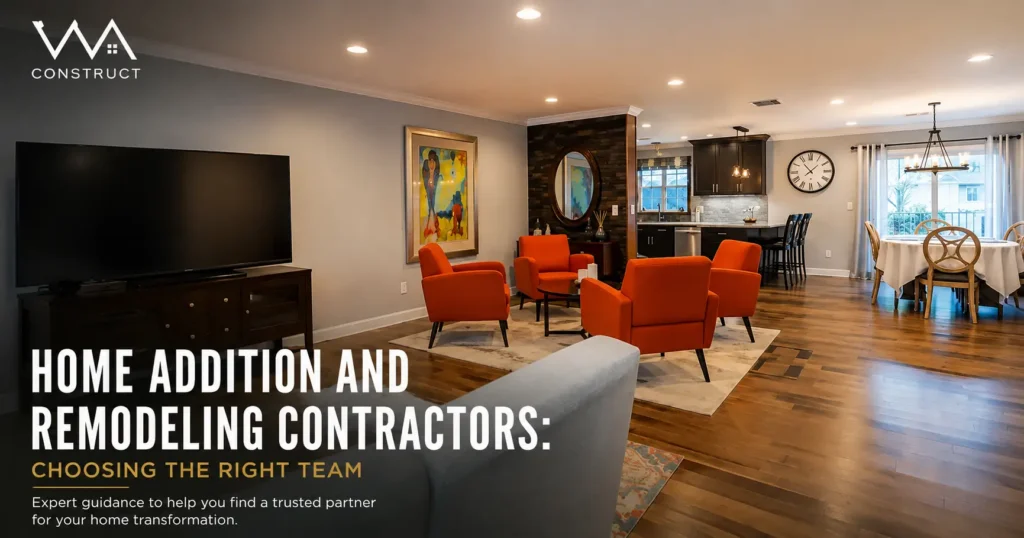
Home Addition and Remodeling Contractors: Choosing the Right Team
Choosing the right contractor for your home addition or remodel is one of the most important decisions you will make before construction begins.
Not the cabinet finish.
Not the tile.
Not the paint color.
The contractor.
Because the right team does more than build the space. They guide the process, protect the vision, manage the details, communicate clearly, and help you avoid the kind of surprises that make homeowners regret starting in the first place.
A home addition can completely change how your family lives. It can give you the larger kitchen you have wanted for years, the first-floor suite your family needs, the extra bedrooms your growing household requires, or the open living space that finally makes your home feel functional. But even the best idea can become stressful if the team behind it is disorganized, unclear, or reactive.
That is why choosing between home addition contractors should never come down to a quick estimate or a good first impression. If you are planning a major Home Remodel Company New Jersey, the goal is to find a contractor who brings structure, transparency, experience, and accountability to the entire process.
A beautiful addition starts with a smart decision.
And that decision starts here.
Why the Right Contractor Matters More Than Homeowners Realize
A home addition is not a weekend project. It affects your home, your schedule, your routines, your budget expectations, and often your daily comfort for months. The contractor you hire becomes the person or team responsible for turning a complicated idea into a livable, finished space.
That requires more than construction skill.
It requires planning.
It requires communication.
It requires documentation.
It requires problem-solving before the problems reach the job site.
Many homeowners begin by looking at design inspiration. That is a great starting point. If you are still exploring home addition ideas in NJ, think carefully about what kind of space will actually improve your day-to-day life. Do you need more room to entertain? Better privacy? A larger kitchen? A multi-generational living setup? A second-floor expansion? A more open layout?
Once the vision becomes clearer, the next step is just as important: finding the right team to execute it. The best home addition contractors are not simply the ones who say yes to your ideas. They are the ones who can explain what is realistic, what needs to be planned early, what may require permits, what selections affect the timeline, and how the project should be managed from start to finish.
That is the difference between building with hope and building with confidence.
The Lowest Bid Is Not Always the Best Value
Everyone wants a fair proposal. That is normal. No homeowner wants to feel like they are overpaying or making a poor financial decision.
But the lowest bid can be misleading.
In construction, two proposals may look like they are describing the same project, but they may not include the same scope, finish level, allowances, project management, permit handling, or warranty support. One contractor may include important details upfront, while another may leave them vague or exclude them entirely.
That is why it is risky to compare proposals based only on the final number. A lower bid may look attractive at first, but if it leaves out important items, it may create confusion later. The real question is not, “Which contractor is cheapest?” The better question is, “Which contractor has explained the project most clearly?”
When reviewing remodeling contractor cost factors, look closely at what is included, what is excluded, what is assumed, and what still needs to be decided. For a deeper understanding, homeowners should review what impacts home addition costs before comparing proposals too quickly.
A clear proposal may not be the shortest proposal.
But it is usually the safer one.
Remodeling Contractor Qualifications to Check Before Hiring
When homeowners search for “remodeling contractors near me,” the results can feel overwhelming. Many companies look professional online. Many have polished photos. Many say they are experienced. But before hiring a home addition contractor, you need to look deeper than the surface.
The right remodeling contractor qualifications should give you confidence that the contractor can manage both the construction work and the process around it. A strong contractor should be properly registered where required, insured, experienced with similar projects, familiar with local permitting, and able to provide a clear written proposal.
Licensing and Insurance
Start with the basics. A contractor should be properly registered or licensed where required and should carry appropriate insurance coverage. This protects both the homeowner and the project. It also shows that the contractor is operating professionally and understands the responsibilities that come with working on someone’s home.
Do not feel uncomfortable asking for proof. A serious contractor will expect the question.
Relevant Project Experience
Not every contractor is the right fit for every project. A contractor who does small cosmetic updates may not be the best fit for a structural addition. A contractor who mainly handles bathrooms may not be prepared for a second-story expansion or a full design-build remodel.
Ask to see projects similar to yours. Look for examples that match your scope, style, complexity, and finish expectations. The more relevant the experience, the more likely the contractor is to understand the decisions and challenges your project may involve.
Strong Remodeling Contractor Reviews
Remodeling contractor reviews can tell you a lot, but only if you read them carefully. Do not just look at the rating. Look at what clients actually mention.
- Do homeowners talk about communication?
- Did the contractor stay organized?
- Were expectations clear?
- Were issues handled professionally?
- Did the team respect the home?
- Did the final result match the original vision?
Good reviews should not only praise the finished product. They should also give you confidence in the experience.
Clear Proposal and Documentation
A vague proposal is one of the biggest warning signs in remodeling. If the proposal does not clearly explain the scope, inclusions, exclusions, allowances, payment structure, and change order process, misunderstandings are more likely to happen later.
A detailed proposal is not just paperwork. It is protection.
It helps the homeowner and contractor stay aligned before construction begins.
Contractor Licensing and Permits: What Homeowners Should Know
Permits are not the most exciting part of a home addition, but they are one of the most important.
Depending on the project scope, your addition or remodel may require building permits, zoning approvals, inspections, trade permits, or other municipal steps. In New Jersey, requirements can vary by township, project type, property conditions, and the nature of the work being performed.
That is why contractor licensing and permits should be discussed early. A qualified contractor should be able to explain what permits may be needed, who is responsible for submitting them, how inspections are handled, and how permitting may affect the schedule.
A contractor who treats permits casually may create problems later. Unpermitted work can lead to inspection issues, delays, resale complications, or required corrections. It is always better to handle the process properly from the beginning.
The right contractor will not make permits feel mysterious.
They will make them part of the plan.
How to Choose a Remodeling Contractor Without Guessing
If you are wondering how to choose a remodeling contractor, start by thinking beyond the proposal. The proposal matters, but it is only one piece of the decision.
You are also choosing a communication style.
- A planning process.
- A project management system.
- A level of transparency.
- A standard of accountability.
A good contractor should make you feel informed, not pressured. They should be able to explain how the project will move from consultation to design, from design to proposal, from proposal to permits, and from permits to construction. If the process feels unclear before you sign, it will probably feel even more unclear once work begins.
Pay attention to how the contractor answers questions. Clear answers are a good sign. Defensive or vague answers are not. A contractor does not need to know every final detail during the first conversation, but they should be able to explain the process for getting those details resolved.
Confidence comes from clarity.
Not charm.
Design-Build vs. Traditional Remodeling Teams
One of the most important choices homeowners make is whether to work with separate design and construction professionals or with a design-build team. Both approaches can work, but they create different experiences.
In a traditional model, plans are often created first and priced later. That can work well when communication is strong and expectations are carefully managed. But it can also create disconnects. A design may look beautiful on paper but require revisions once construction pricing, structural realities, or permitting requirements are reviewed.
In a design-build model, design and construction planning are connected earlier. This can help homeowners understand how layout choices, materials, finishes, structural decisions, and timeline considerations affect the overall project. It also reduces the risk of having separate teams point fingers when something changes or needs clarification.
For homeowners comparing addition builders, the middle of the decision often comes down to coordination. If you are trying to understand how to find the best addition builders, look for teams that can connect design ideas with practical construction planning.
The goal is not just to create a beautiful plan.
The goal is to create a plan that can actually be built well.
Questions to Ask a Remodeling Contractor Before Signing
The questions you ask before hiring a contractor can reveal how the project will feel later.
A polished presentation is helpful, but the real test is how clearly the contractor explains their process. Before signing, homeowners should ask practical questions that uncover how the contractor handles scope, communication, selections, permits, delays, and changes.
Here are the most important questions to ask a remodeling contractor:
- What is included in the proposal?
- What is excluded from the proposal?
- How are allowances handled?
- How do you document and approve change orders?
- Who will be my main point of contact?
- How often will I receive updates?
- How are selections tracked?
- Who manages permits and inspections?
- What happens if the schedule changes?
- What warranty or post-project support is provided?
The answers should feel specific. If the contractor relies on phrases like “we will figure it out,” “do not worry,” or “that usually works itself out,” ask for more detail.
A professional contractor should not be bothered by good questions.
They should welcome them.
What a Strong Contractor Proposal Should Include
A proposal should do more than give you a general idea of the work. It should help you understand exactly what you are agreeing to.
A strong proposal should explain the scope of work, major materials, finish expectations, allowances, exclusions, project assumptions, payment milestones, and change order procedures. It should also identify responsibilities. For example, who handles permits? Who orders the finish materials? Who tracks approvals? Who communicates with the homeowner?
The more complex the project, the more important this becomes. A home addition involves many moving parts: structural work, mechanical systems, design decisions, inspections, weather considerations, finish selections, and coordination between multiple trades.
A short proposal may feel simple.
But simple is not always safe.
The best proposals reduce confusion before construction begins.
Red Flags to Watch for When Hiring a Home Addition Contractor
Sometimes homeowners sense that something feels off, but they ignore it because they like the price, the personality, or the speed of the response. That can be a mistake.
There are several red flags to watch for before hiring a home addition contractor. Be cautious if a contractor avoids detailed questions, provides a vague proposal, cannot explain exclusions, does not discuss permits, refuses to provide proof of insurance, or pressures you to move forward before you fully understand the scope.
Also, pay attention to communication. If it is hard to get clear answers during the sales process, communication will likely not improve during construction. If a contractor is disorganized before they have the job, they may be even more disorganized after they get it.
A good contractor brings calm to the process.
Not confusion.
Homeowner Checklist Before Hiring Home Addition Contractors
Before making your final decision, use a simple checklist to compare contractors more clearly. This helps you move beyond personality and price so you can evaluate the things that actually affect the project experience.
Before signing, confirm that the contractor:
- Is properly registered or licensed where required
- Carries appropriate insurance
- Has relevant experience with similar projects
- Can provide remodeling contractor reviews or references
- Offers a clear written proposal
- Explains inclusions and exclusions
- Defines allowances clearly
- Has a process for change orders
- Explains who handles permits and inspections
- Provides a clear communication structure
- Uses a system for tracking selections and approvals
- Offers warranty or post-project support
- Can explain how the schedule will be managed
This checklist does not decide for you, but it helps you ask better questions.
And better questions lead to better outcomes.
How the Right Contractor Experience Should Feel
The right contractor experience should feel organized from the beginning. You should understand what happens next, who you will communicate with, what decisions are needed, how approvals are documented, and how updates will be shared.
- You should not feel like you are chasing information.
- You should not feel like every answer depends on memory.
- You should not feel like the process changes every week.
A professional remodeling experience should feel structured, even when the project itself is complex. There should be a clear path from the first consultation to the final walkthrough. There should be documentation. There should be communication. There should be accountability.
That does not mean every project is effortless. Construction still involves decisions, coordination, inspections, and occasional adjustments. But the right contractor makes those moments manageable because the process is already built to handle them.
That is what homeowners should look for.
Not perfection. Preparedness.
Choosing the Right Team for Your Home Addition or Remodel
The best home addition contractors are not always the loudest, cheapest, or most available. They are the ones who can explain the process clearly, document the details carefully, communicate consistently, and manage the project with professionalism.
When comparing contractors, look for the team that makes you feel informed rather than rushed. Look for the proposal that gives you clarity rather than confusion. Look for the contractor who asks thoughtful questions, explains risks early, and helps you understand the decisions ahead.
A home addition is too important to leave to assumptions. The contractor you choose will influence not only the finished space but the entire experience of getting there.
- Choose the team that brings clarity.
- Choose the team that brings structure.
- Choose the team that treats your home like something worth planning properly.
Ready to Plan Your Home Addition with WA Construct?
If you are preparing for a home addition or major remodel in New Jersey, WA Construct can help you move forward with more clarity, confidence, and control. Our design-build process brings planning, interior design, construction coordination, selections, communication, and project management under one organized team, so your project feels guided from the beginning.
We focus on detailed proposal clarity, strong communication, thoughtful planning, and a smoother homeowner experience. From the first conversation to the final walkthrough, our goal is to help you understand your options, avoid unnecessary surprises, and build with a team that respects your home, your time, and your vision.
When you are ready to take the next step, schedule your consultation and start planning your project with a team that values clarity, communication, and craftsmanship.
Connect with Our Trusted Experts Today — 📞 201-485-8887
Look for proper registration, insurance, relevant project experience, clear proposals, strong reviews, and organized communication. The best contractors can explain their process clearly before you sign.
Search beyond location. Review portfolios, client feedback, proposal details, communication habits, and whether the contractor has experience with projects similar to yours.
Ask about scope, exclusions, allowances, change orders, permits, communication, project updates, warranty, and who will manage your project day to day.
Bids vary because the scope, allowances, finish levels, exclusions, planning depth, and project management differ. A lower proposal may not include the same level of detail.
Verify that the contractor is properly registered or licensed where required, carries insurance, and can explain how permits and inspections will be handled.
Yes, but it must be planned from the beginning. A bonus room requires enhanced foundation design, structural framing, insulation, access planning, and mechanical considerations.
Choose a contractor with strong planning, clear selection deadlines, organized communication, and a defined scheduling process. Many delays begin with decisions left unresolved.
Design-build connects design and construction planning under one coordinated process. Traditional construction often separates the design team from the building team.
The right contractor should make you feel informed, not pressured. Look for clear answers, relevant experience, strong documentation, and a process that feels organized.