
The best quality home builder for your project is the one whose work holds up in the parts of the house you will never see again after drywall: the framing, the flashing, the air sealing and the systems inside the walls. Finishes matter too, but they go in last, and they are the easiest part of a house to make look good on a tour.
No ranking can tell you which builder that is, because quality shows up house by house. What you can do is judge the evidence. A builder who builds well will show you a house under construction, explain how each stage is checked and put the warranty terms in writing. This guide walks through what to look for at each stage of a new custom home in New Jersey.
Start with the framing
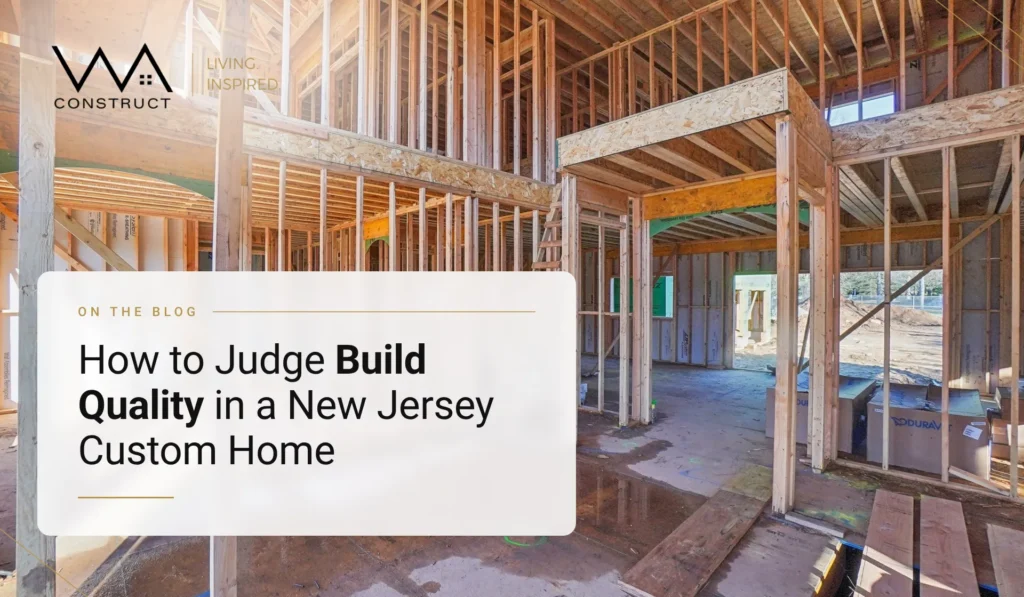
Framing is the skeleton of the house, and most quality problems that show up years later trace back to it. Walls should be straight and plumb, and floors should be flat. Openings for windows and doors need properly sized headers, which are the beams that carry the load over each opening. Where the plans call for engineered beams or posts, they should be installed as drawn, with the hardware the engineer specified.
Good framers also think ahead. They add solid wood blocking inside the walls where cabinets, railings, grab bars, wall mounted TVs and heavy mirrors will hang. They keep lumber dry, or let it dry out before the walls are closed, so it does not shrink and crack drywall later. Ask to walk the house at the framing stage, before insulation goes in. It is the one time you can see how the house is actually built.
Check how the house sheds water
Water is what damages houses over time, so a quality builder treats every place water could get in as a detail to solve. The sheathing on the outside of the framing should be covered with a weather barrier, either a housewrap or a sheathing system with taped seams. Every window and door needs flashing, which is a layer of membrane or metal that directs water out and away from the opening, with a sill pan or sloped sill at the bottom. Where a roof meets a wall, a small piece called kickout flashing should send water into the gutter instead of down the siding. Below grade, the foundation needs waterproofing or dampproofing and a drainage system that carries water away from the footings. The ground around the house should slope away from it on every side. Ask the builder to show you each of these on a house in progress, and to explain who checks them before siding and roofing cover them up.
Ask how the insulation and air sealing are checked
A house can have the right insulation on paper and still be drafty if gaps are left around wires, pipes, top plates and attic hatches. Air sealing closes those gaps, and a blower door test measures how well it was done. In that test, a fan mounted in an exterior door depressurizes the house so the amount of air leaking in can be measured.
Ask each builder whether they test every home, what result they aim for and whether they share the report with the owner. Ask how the house is ventilated, too. A tight house needs planned fresh air, usually through a dedicated ventilation system. The ENERGY STAR new homes program is a good reference for what a well sealed, well ventilated new house includes.
Know what New Jersey requires
Some quality checks come from the state. New homes in New Jersey are built under the Uniform Construction Code. The town’s construction office reviews the drawings, issues the permit and inspects the work at set stages, including footings, foundation, framing, rough plumbing, electrical and mechanical work, insulation and a final inspection before a certificate of occupancy is issued.
New home builders must register with the Department of Community Affairs and enroll each new home in a new home warranty program. Under that program, coverage runs one year for workmanship and materials, two years for mechanical, electrical and plumbing systems, and ten years for major structural defects. Inspections and the warranty set a minimum. A quality builder plans to exceed that minimum and documents the work along the way.
Look at the finishes last
Finishes are where quality is easiest to see, so look closely. Tile should sit flat, with consistent grout lines and no lips between tiles. Trim joints should be tight, paint lines clean and doors should close without rubbing. Cabinet boxes, drawer slides and hinges tell you more about long term quality than the countertop does. Our article on the cabinet question nobody asks explains what to check inside the box.
When you tour a finished home, open the drawers, look under the sinks and check the corners of closets and the basement. Builders who care about quality finish the places most buyers never check.
Build quality checklist for a new custom home
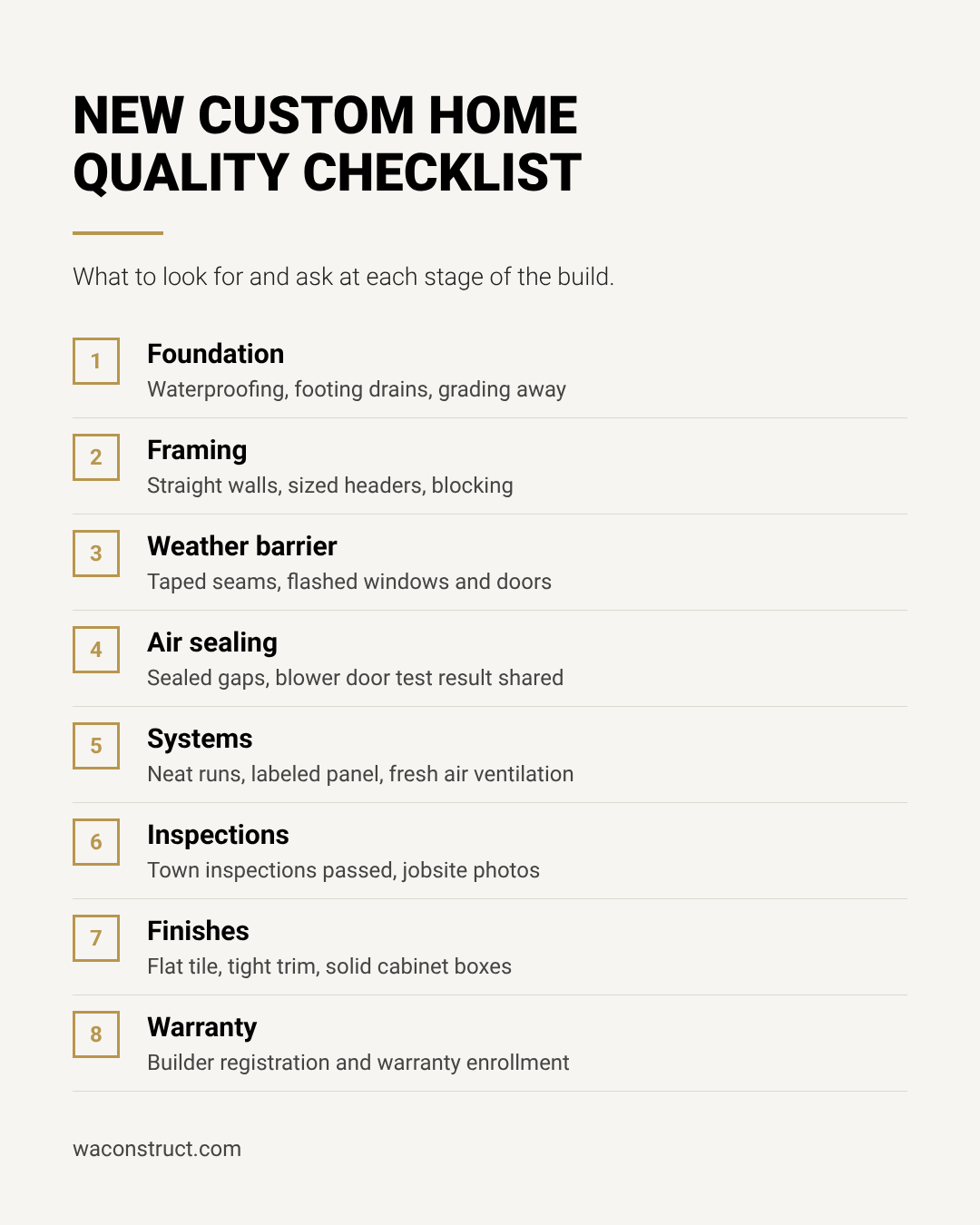
Stage | What to look for | What to ask the builder
|
|---|---|---|
Foundation | Waterproofing, footing drains, grading away from the house | How is water carried away from the foundation? |
Framing | Straight walls, sized headers, engineered beams as drawn, blocking | Can I walk the house before insulation? |
Weather barrier | Taped seams, flashed windows and doors, kickout flashing | Who checks flashing before siding goes on? |
Insulation and air sealing | Sealed gaps at wires, pipes, top plates and attic hatches | Do you blower door test every home and share the result? |
Systems | Neat runs, labeled panel, planned fresh air ventilation | How is the house ventilated? |
Inspections | Passed town inspections at each stage | Will I see inspection results and jobsite photos? |
Finishes | Flat tile, tight trim, smooth doors, solid cabinet boxes | What standard do you use for the final punch list? |
Warranty | Builder registration and new home warranty enrollment | Which warranty program is the home enrolled in? |
How to compare builders on quality
Ratings and reviews tell you how clients felt about the experience. They tell you less about what is inside the walls. To compare builders on build quality, ask to visit a home under construction as well as a finished one. Ask for references from owners who have lived in their homes for a few years, since that is when hidden problems surface. Look at awards judged by industry peers, and read reviews for how the builder handled a problem, which says more than how the project went when everything was smooth. Finally, check that the builder is registered with the state and ask which new home warranty program they use.
How WA Construct approaches build quality
At WA Construct, quality is checked at every stage, and our clients see it for themselves through 24/7 access to a client portal with jobsite photos and updates as the house goes up. Our custom home work earned the 2026 SAM Award for Best Custom Home. You can see recent projects on our custom homes page.
If you are planning a new custom home, tell us about your project: your New Jersey town, the work you are considering, where your plans stand and the main question you want answered. We start with a Zoom discovery conversation. If the project is a fit, we meet at your home for a consultation, then walk you through a detailed proposal at our office.