
Family Room Addition Fireplace Ideas: What Works in 2026 (And What Doesn’t)
I’ve installed over 200 fireplaces in family room additions across North Jersey. The homeowners who still feel good about their choice five years later all made one decision differently from those who don’t.
They chose function before fashion.
The fireplace you select for your family room addition isn’t just a design statement. It’s a long-term design decision that affects maintenance, layout flexibility, and daily comfort. Get it wrong, and you’ll spend years working around a choice that no longer fits how you use the room.
The decision becomes even more complex when you factor in entertainment centers and smart home integration.
These three elements, fireplaces, media systems, and technology, don’t exist in isolation. They compete for wall space, electrical planning, and visual dominance. How you balance them determines whether your family room addition becomes the home’s gathering hub or a room that feels harder to use than expected.
The New Reality of Family Room Addition Fireplace Ideas
Fireplace selection in 2026 has shifted. Homeowners no longer choose between gas and wood-based systems purely on aesthetics. They’re looking for better heat control while still maintaining visual impact.
This changes how homeowners should think about fireplace planning in a family room addition.
Linear fireplaces dominate luxury additions right now. These sleek, horizontal systems create striking focal points in open-plan spaces. I’ve watched designers push these units wider and wider to match the scale of modern family rooms, where fireplaces become architectural foundations rather than simple features.
But linear isn’t always right.
In smaller family room additions under 250 square feet, oversized linear fireplaces can overwhelm the space. A traditional 36-inch gas insert often provides better proportional balance without dominating the room.
When homeowners start comparing everything about fireplaces, the decision usually comes down to scale, heat output, maintenance, and how the unit fits the room.
In North Jersey’s colder climate, fireplaces also remain an important comfort feature in family room additions, which is one reason this decision tends to carry so much weight for homeowners.
Fireplace vs Entertainment Center: The Wall Space Battle
Here’s where most fireplace ideas during a family room addition fall apart in execution.
Homeowners envision a dramatic fireplace on one wall and a large entertainment center on another. Then reality hits: their 14-foot-wide family room addition doesn’t have two focal-point walls. They’re forced to choose or compromise.
The decision between a fireplace and an entertainment center isn’t just about preference; it’s also about space and clearance.
When you place a fireplace and TV on the same wall, you face heat clearance requirements. Most manufacturers specify minimum clearances between fireplace openings and nearby combustible materials. Mounting a TV directly above a traditional fireplace can create both performance and warranty concerns, which is why placement decisions should be made carefully.
Three Proven Layouts for Fireplace vs Entertainment Center Integration
I’ve solved this fireplace-and-media-wall conflict dozens of times. Three approaches consistently work in family room additions.
Layout One: Side-by-Side Integration
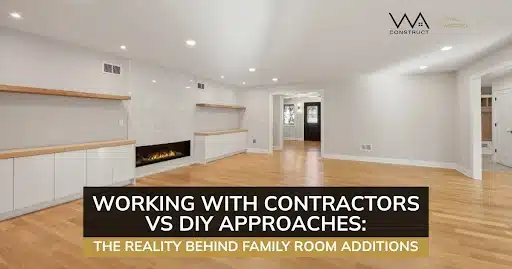
Place a linear fireplace and wall-mounted TV on the same wall with proper heat shielding between them. This works when your addition wall spans at least 16 feet, and you use low-heat electric or sealed-combustion gas units. The fireplace occupies the lower third, the TV the upper third, with built-in cabinetry flanking both sides for visual balance.
This comprehensive approach creates visual cohesion while solving the dual-focal-point challenge most homeowners face.
Layout Two: Opposing Walls
Position the fireplace on one wall, the entertainment center on the opposite wall. This creates two focal points and works beautifully in family room additions 18 feet or wider. Furniture is arranged in the middle, allowing comfortable viewing angles to both features.
This layout works beautifully when you have adequate square footage and want distinct zones for different activities.
Layout Three: Corner Fireplace with Media Wall
Install a corner fireplace unit and dedicate the longest wall to a full entertainment center. This maximizes usable space in family room additions where multiple windows limit available wall area. Corner fireplaces create visual interest without dominating the primary sightline.
This approach delivers maximum functionality when architectural constraints limit your wall options.
The Heat Shield Solution
When clients strongly prefer TV-over-fireplace placement, I install professional heat shield systems. These aren’t DIY solutions. They’re engineered barriers that redirect heat away from electronics while maintaining code compliance.
Proper heat shields protect your AV equipment while maintaining code compliance. I only recommend this approach with low-output electric or sealed gas units, never with traditional wood-burning fireplaces.
If the plan includes a TV on the same wall, hanging a flat-screen TV becomes part of the layout discussion because placement and heat management need to be resolved together.
Smart Home Integration Family Room: The Infrastructure Nobody Plans For
Here’s what surprises homeowners every time.
Most clients initially underestimate what comprehensive smart integration actually involves.
Planning smart technology in a family room isn’t about buying devices; it’s about building infrastructure that lasts.
You need dedicated electrical circuits for motorized shades, network drops for streaming devices, control panels for lighting scenes, and integration platforms that tie everything together. When you extend your home into a new family room addition, you’re also extending your home’s technological infrastructure.
Your family room addition may eventually house several of those systems: smart lighting, climate control, motorized shades, security cameras, and entertainment devices. Each needs power, network access, and thoughtful placement during construction, not after drywall installation.
Planning a smart home system early helps you think through wiring, control locations, and device placement before the walls are closed.
What Smart Home Integration Family Room Projects Actually Include
When I scope smart technology for family room additions, comprehensive packages typically include these core components:
Network Infrastructure: Cat6 cable runs to every wall, a dedicated network switch, and a Wi-Fi access point for reliable coverage throughout the addition.
Smart Lighting: LED recessed lights with dimming capability, wall switches with scene programming, and integration with voice control platforms.
Climate Control: Dedicated smart thermostat zone for the addition, automated vents, and integration with the home HVAC system.
Entertainment: In-wall speaker pre-wire, soundbar mounting with concealed wiring, streaming device infrastructure.
Window Treatments: Motorized shades with scene integration, dedicated circuits, remote, and voice control.
Control Platform: Central hub that manages all systems, app configuration, and integration testing.
The Smart Fireplace Revolution
Fireplace planning has evolved beyond manual operation. Smart fireplaces with app-controlled ignition, automated flame height adjustment, and thermostat integration let you monitor performance from your phone without crossing the room.
This integration matters significantly when planning from scratch.
Running the electrical and network infrastructure during construction avoids disruptive retrofits later.
Smart fireplaces can also reduce friction in the fireplace vs entertainment center debate. When your fireplace responds to voice commands and automatically adjusts output based on room temperature, you don’t need constant visual access to controls. This can free up wall space for entertainment center placement without sacrificing fireplace functionality.
The Integration Nobody Expects
The most sophisticated entertainment center designs in family room additions now incorporate fireplace control panels directly into cabinetry. Touch screens mounted in built-ins manage fireplace operation, lighting scenes, shade positions, and AV systems from a single interface.
This level of integration requires coordination during design, not during installation. Your cabinet maker needs to know about the control panel dimensions. Your electrician needs to run circuits to cabinet locations. Your AV integrator needs to program interfaces before trim carpentry starts.
When these trades work as separate contractors hired at different times, important details can fall through the gaps.
When they work as one design-build team with shared project documentation, the integration happens much more smoothly.
The Pre-Construction Decision Map
I walk clients through a specific decision sequence during residential addition projects that transform how families use their homes. The order matters because each choice constrains the next.
Step One: Define Primary Function
Is your family room addition primarily for media consumption, family gathering, or entertaining guests? This determines whether your entertainment center or fireplace takes visual priority. Media-focused rooms center on the TV. Gathering-focused rooms center on the fireplace. Entertainment-focused rooms often need both to be equally accessible.
Step Two: Map Wall Constraints
Identify every wall limitation: windows, doors, structural posts, HVAC vents, and electrical panels. What remains determines your layout options for fireplace and entertainment center placement. I’ve seen clients fall in love with layouts that their actual wall dimensions make impossible; poor floor plan decisions create avoidable layout conflicts later.
Step Three: Select Fireplace Type
Based on available wall space and primary function, choose between linear, traditional insert, corner, or double-sided fireplaces. Each type has different clearance requirements that affect entertainment center options. This decision must happen before architectural drawings are finalized because the fireplace type affects structural framing.
Step Four: Design Entertainment Center Integration
With the fireplace location locked, design your entertainment center around the remaining wall space. Determine built-in versus freestanding, storage requirements, equipment cooling needs, and cable management approach. This step identifies electrical and network infrastructure requirements.
Step Five: Plan Smart Home Infrastructure
Map out every smart device, network drop, dedicated circuit, and control panel location. Identify integration points between fireplace controls, entertainment systems, lighting, and climate management. This creates your electrical and low-voltage rough-in drawings.
Step Six: Document Everything
Lock all decisions into construction drawings before ground breaks. Every fireplace specification, every entertainment center detail, every smart home device gets documented. This eliminates the scope creep that derails timelines and project scope.
What Success Actually Looks Like
I completed a 320-square-foot family room addition in Montclair last year that demonstrates this approach clearly.
The clients initially wanted a traditional fireplace on the north wall and a separate entertainment center on the south wall. Their space could accommodate both, but the furniture arrangement created by opposing focal points left the center of the room awkwardly empty.
We redesigned around an integrated function.
We installed a 72-inch linear electric fireplace with integrated heat shield technology on the primary wall. Directly above, we mounted a 75-inch TV with all wiring concealed in-wall. Flanking both sides, we built custom cabinetry housing AV equipment, storage, and a central control panel managing fireplace, lighting, and motorized shades.
The integration created a seamless system where technology serves a function without visual clutter.
The result: one cohesive focal point that serves both media consumption and ambiance without requiring furniture to face multiple directions. The family uses the space daily, and guests consistently comment on how naturally everything works together.
That’s what proper planning delivers: not just functional space, but space that supports how you actually live.
Making Your Family Room Addition Work for the Next 20 Years
The gap between family room additions that homeowners love and those they regret isn’t craftsmanship; it’s planning clarity.
When you address fireplace planning, media-wall trade-offs, and smart home infrastructure during design rather than during construction, you eliminate many of the conflicts that create avoidable frustration later.
I’ve systematized this planning process over 19 years and hundreds of projects.
The decisions you make about fireplaces, entertainment centers, and smart home systems cascade through every aspect of construction. Miss them during planning, and you’ll spend the build reacting to corrective compromises.
That’s why I use comprehensive documentation that locks the scope before ground breaks. It protects your vision and supports a more predictable construction process.
If you want expert guidance, a strategy call with WA Construct can help you think through fireplace design, entertainment systems, and smart home technology as one cohesive plan.
Before you commit to any design decisions, understand the complete process of planning a family room addition in New Jersey, which requires navigating structural requirements, municipal codes, and design integration that many homeowners do not fully see at the beginning.
Frequently Asked Questions
Linear electric or sealed-combustion gas fireplaces often offer the best balance of performance, safety, and integration flexibility for modern family room additions. They provide clean aesthetics, controllable heat output, and better compatibility with above-fireplace TV placement when properly planned.
Yes, but only with professional heat shield systems and low-output fireplace types such as electric or sealed gas. Traditional wood-burning fireplaces generate too much heat for safe TV placement. Proper heat shielding helps protect electronics while maintaining code compliance.
Smart home integration usually requires dedicated network infrastructure, smart lighting systems, climate control, entertainment pre-wire, motorized shades, and integrated control platforms. The scope goes beyond buying devices; it involves building infrastructure that needs to be planned during construction.
Built-in entertainment centers usually offer better integration with fireplaces and smart home systems. Choose built-in if you want a more seamless long-term solution. Choose freestanding if layout flexibility matters more than custom integration.
Lock fireplace type, entertainment center approach, and smart home infrastructure decisions before finalizing architectural drawings. These choices affect structural framing, electrical planning, HVAC calculations, and network infrastructure, all of which become harder to change once construction begins.
Start by deciding what the family room will be used for most often. If the space is mainly for media, the entertainment center should usually take priority, but if the room is designed for gathering and atmosphere, the fireplace may become the focal point. In many additions, the best solution is an integrated wall that balances both features carefully.
Smart fireplaces can be worth considering when convenience, comfort, and integration matter. They allow homeowners to control ignition, flame height, and heat output through apps, remotes, or smart home systems. When planned during construction, they can fit cleanly into the overall fireplace, media, and lighting design.
Fireplace planning should happen early because the fireplace affects framing, wall layout, electrical work, heat clearance, TV placement, and smart home infrastructure. Waiting until construction begins can limit your options and create expensive changes. Early planning helps the fireplace, entertainment center, and technology work together as one complete system.