
Your roof is one of the most critical components of your home. When it starts failing, the clock starts ticking, and so does the pressure to make a fast, expensive decision without enough information.
Most New Jersey homeowners walk into the bidding process completely blind. They collect a few estimates, pick the lowest number, and hope for the best. That approach almost always ends with budget overruns, unexpected change orders, and a contractor relationship built on friction instead of trust.
This guide breaks down everything you need to know about the new roof cost in New Jersey, what drives it, what to watch out for, and how to make a decision you won’t regret. Whether you’re planning a full exterior overhaul or a targeted roof replacement as part of a broader home remodeling work, understanding real cost drivers puts you in control before anyone shows up with a clipboard.
Why Roof Replacement Costs Vary So Much in New Jersey
There’s no single number that defines a roof replacement. The average roof replacement cost in New Jersey spans a wide range, depending on five core variables, and most homeowners only think about one of them (material) when they should be thinking about all five.
1. Roof Size and Complexity
Roofing is priced by the square (100 square feet). A simple gable roof on a 1,500-square-foot home costs far less than a complex hip-and-valley system on a 3,000-square-foot custom home. Every dormer, skylight, chimney penetration, and roof plane transition adds labor hours and material waste. Understanding the roof replacement cost per square foot in New Jersey starts with an honest assessment of your roof’s actual complexity, not just its footprint.
2. Material Selection
Material is where most homeowners anchor their thinking and where the biggest cost swings happen. Each material carries a different price point, lifespan, and performance profile suited to New Jersey’s climate. More on this in the next section.
3. Labor Costs
The labor cost for a new roof in New Jersey represents roughly 55 to 65 percent of your total project cost. Northern NJ counties Bergen, Essex, Morris, and Union run higher than central or southern regions due to proximity to the New York metro labor market. Experienced, licensed crews command premium rates. That premium is worth paying. Cheap labor almost always means compromised installation, and installation quality determines how long any material actually lasts.
4. Tear-Off and Disposal
Removing your existing roof layers adds cost that many low-bid contractors bury or omit entirely from initial estimates. If a quote doesn’t explicitly include tear-off, decking inspection, and disposal, it will show up as a change order later. Get it in writing before you sign anything.
5. Permits and Inspections
Most New Jersey municipalities require permits for full roof replacements. If decking replacement, structural modifications, or ventilation upgrades are involved, permit requirements become more complex. Contractors who ask homeowners to pull their own permits are signaling something important: they’d rather avoid municipal oversight. Professional firms handle permitting and include the cost in their proposal.
If you’re thinking about a broader exterior transformation alongside your roof, the planning considerations go well beyond shingles and decking. Exterior remodeling projects that transform how your home looks, feels, and performs require the same upfront coordination and the same commitment to fixed pricing and no-surprise delivery.
Roofing Material Options: What New Jersey Homeowners Are Actually Choosing
Material selection is the single biggest lever on your final cost. Here’s what each option delivers and what it costs relative to the others.
Asphalt Shingle Roof Cost in New Jersey
Architectural asphalt shingles remain the most common choice for NJ homeowners. They offer solid weather performance, a range of aesthetic options, and the most competitive price point of any material. The asphalt shingle roof cost in New Jersey varies based on shingle grade (3-tab vs. architectural vs. designer), roof complexity, and labor market conditions in your county. Lifespan typically runs 20 to 30 years with proper installation and ventilation.
Metal Roof Cost in New Jersey
Standing seam metal roofing runs two to three times the cost of architectural asphalt, but it lasts 40 to 70 years with minimal maintenance. The metal roof cost in New Jersey reflects both premium materials and more specialized installation labor. For homeowners planning to stay in their home long-term, the cost-per-year calculation often favors metal once you factor in replacement cycles and maintenance savings. Metal also performs exceptionally well under NJ’s freeze-thaw winter conditions.
Tile Roof Cost in New Jersey
Clay and concrete tile deliver outstanding longevity, often 50 years or more, and a premium aesthetic that significantly elevates curb appeal. The tile roof cost in New Jersey is among the highest of any residential roofing material, and tile requires a structural evaluation before installation. Your roof framing must support the added weight. Not every home qualifies without reinforcement, which adds to the total project cost.
Flat Roof Replacement Cost in New Jersey
Flat and low-slope roofs common on additions, garages, and some contemporary home designs use different materials entirely: TPO, EPDM, modified bitumen, or built-up roofing systems. The flat roof replacement cost in New Jersey depends heavily on square footage, membrane type, and drainage configuration. Flat roofs require more frequent inspection and maintenance than pitched systems, so factor ongoing costs into your material decision.
Cheapest New Roof Options in New Jersey
If budget is the primary constraint, the cheapest new roof options in New Jersey center on standard 3-tab asphalt shingles. They cost less upfront but carry a shorter lifespan and less wind resistance than architectural grades. For homeowners planning to sell within 5 to 10 years, this can be a reasonable trade-off. For those staying long-term, the math usually favors spending more upfront on architectural shingles or entry-level metal.
Thinking about other exterior upgrades alongside your roof? A roof replacement is often the right time to look at the bigger picture because exterior changes rarely happen in isolation. Siding, windows, trim, gutters, roofline details, and structural repairs can all affect the final budget. That is why understanding exterior renovation cost in New Jersey helps homeowners prioritize what should be handled now, what can wait, and how to avoid paying twice for overlapping labor, access, or material setup.
The Change Order Trap: Why the Lowest Bid Seldom Delivers the Lowest Cost
This is the part most contractors hope you don’t understand before you sign.
Here’s how it works. You collect three bids. The range is significant, maybe $14,000, $18,500, and $21,000. You pick the $14,000 bid because it feels responsible. Work starts. Then the calls begin.
Week two: rotted decking discovered. Add $2,800. Week three: ventilation upgrade required by your municipality’s inspector. Add $1,400. Week five: The underlayment spec in the original bid was thinner than code requires for your county. Upgrade adds $1,100.
Your $14,000 roof now costs $19,300 more than the mid-range bid you passed on. And you’ve spent three weeks arguing about pricing instead of watching your project move forward.
This pattern isn’t accidental. Contractors who don’t conduct thorough site due diligence upfront build their margins through change orders after you’re already committed. The low bid wins the job. The change orders deliver the profit.
The antidote is straightforward: demand a fixed-price contract based on real site analysis, not a ballpark estimate based on a 20-minute walkthrough.
What a Real Fixed-Price Proposal Looks Like
- Explicit material specs (brand, grade, weight, color)
- Defined labor scope with phase breakdowns
- Tear-off, disposal, and decking inspection included
- Permit costs and handling included
- Ventilation assessment and any required upgrades priced in
- Clear exclusions list so nothing is ambiguous
- Timeline with milestone markers
If a contractor can’t provide this level of detail, they haven’t done the upfront work required to give you a real number. Their estimate is a guess. Guesses become change orders.
Using a Roof Cost Calculator in New Jersey
What It Can and Can’t Tell You
Online roof cost calculators for New Jersey are useful for building rough expectations and a baseline range before you enter the bidding process. They typically ask for roof square footage, pitch, material preference, and zip code, then return an estimated range.
Use them for orientation, not decision-making.
Calculators can’t assess your decking condition, ventilation configuration, structural capacity for heavier materials, or local permit requirements. They can’t flag the rotted fascia that will add $1,200 once discovered. They can’t account for whether your attic has adequate ventilation for the shingle grade you’re considering.
According to HomeAdvisor roofing cost data, online estimates frequently understate final project costs by 15 to 30 percent because they can’t capture site-specific conditions. Use calculators to calibrate your expectations. Use a detailed site inspection to get your actual number.
Siding and Roof: Planning Both at the Same Time
Many homeowners discover during the roofing process that their siding is in a similar condition to the roof and that coordinating both projects under one contractor delivers significant savings on mobilization, scaffolding, and project management overhead.
If you’re evaluating your home’s full exterior envelope, understanding the full cost picture for siding alongside roofing helps you make a smarter sequencing decision. What it costs to reside a house depends on the same variables as roofing material choice, home size, labor market, and contractor approach to upfront pricing.
How WA Construct Approaches Roofing Cost Transparency
At WA Construct, we don’t give estimates. We give completion costs.
The difference is more than semantic. An estimate is a starting point that shifts as conditions are discovered. A completion cost is a contractual commitment grounded in thorough site analysis, detailed material specifications, and identification of potential issues before construction begins.
Our Process
Site Due Diligence Before Pricing: We inspect your roof structure, evaluate the decking condition, assess the attic ventilation, and identify anything that could generate a change order later. If there’s rotted wood, we price it now. If your ventilation is inadequate, we address it in the proposal, not after you’ve already signed and committed.
Detailed Proposals, Not Ballpark Quotes: Our proposals document every material specification, labor phase, timeline milestone, and exclusion in plain language. You know exactly what’s included and what’s not before you sign. No fine print surprises. No invoice shock at completion.
Fixed-Price Contracts With Timeline Guarantees: We commit to a completion date and back it with contractual penalties. If our team causes delays, we pay weekly penalties. You carry zero schedule risk from our side. This is a structural accountability mechanism, not a marketing promise.
BuilderTrend Project Portal: Every client gets 24/7 access to project communications, material selections, timelines, and documentation through our BuilderTrend portal. You’re never left wondering what’s happening on your property while you’re at work.
Over 95% of our clients complete their projects with no unexpected change orders after contract signing. That number reflects the investment we make in pre-construction planning and the discipline we apply to upfront due diligence.
Questions to Ask Any Roofing Contractor Before You Sign
- “What’s explicitly included in this price, and what’s excluded?”
Get specifics on tear-off, disposal, permits, ventilation, and decking inspection. “Everything” is not an answer.
- “How do you handle unforeseen conditions like rotted decking?”
Professional contractors conduct pre-construction inspections to minimize surprises. Their answer reveals whether they’ve done the work.
- “Do you provide a fixed-price contract with timeline penalties?”
Words are negotiable. Contractual penalties are structural. If they can’t back their timeline with accountability, ask why.
- “Who pulls the permit, and is the cost included?”
Licensed professional contractors handle permits and include the cost. Asking you to pull your own permit is a red flag.
- “What warranties do you provide on labor and materials?”
Manufacturer warranties cover materials; labor warranties cover installation. Get both in writing with clear terms.
- “Can I see references from projects in my specific county?”
Local references matter. Permit processes, code requirements, and material availability vary across NJ municipalities.
Ready to Get a Real Number, Not an Estimate?
If you’re planning a roof replacement as part of a larger home renovation in North or Central New Jersey, you deserve a completion cost backed by real site analysis, not a ballpark figure that shifts after you’ve signed.
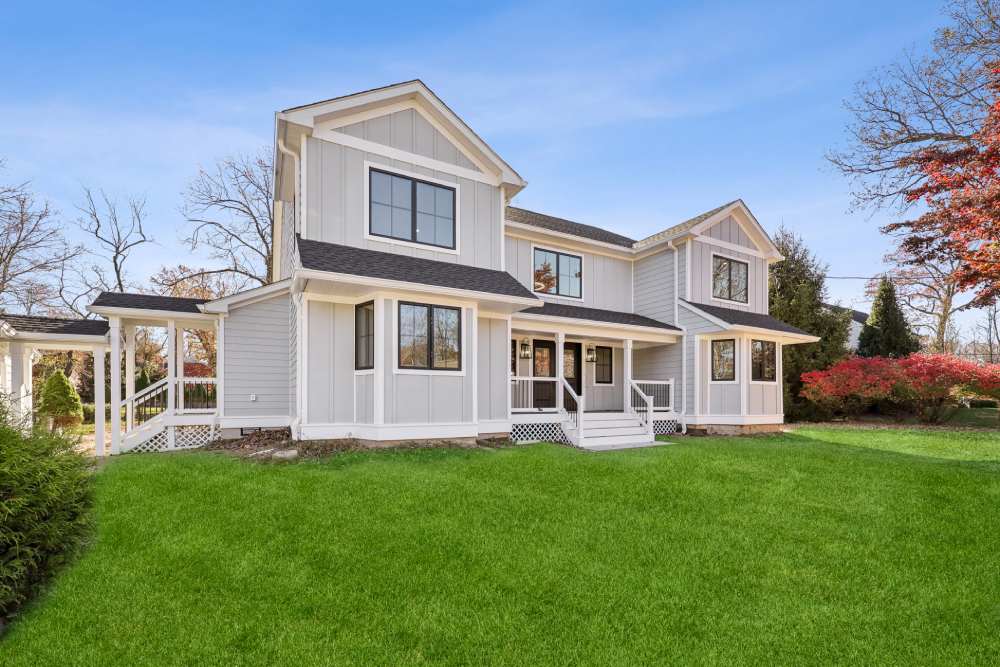
Custom home remodel with new siding, gabled rooflines, black-framed windows, front porch addition, and upgraded exterior finishes.[/caption]
WA Construct delivers fixed-price proposals, timeline guarantees with contractual penalties, and a process built to eliminate the surprises that turn good projects into expensive frustrations.
Award-winning results. Zero-cost initial consultation.
Schedule your no-cost consultation today and get the clarity your project deserves before a single nail goes in.